The Need for Leadership in Conservation
Ontario’s species-at-risk framework has undergone significant transformation since 2020. For organizations involved in conservation, restoration, forestry, and environmental stewardship, the pace and scale of these changes have created both challenges and uncertainty around how species recovery will be achieved in the years ahead.
For us, this evolving landscape reinforces the importance of meaningful collaboration, science-based conservation, long-term genetic stewardship, and recovery approaches that extend beyond policy cycles.
A Period of Significant Legislative Change
Ontario’s Endangered Species Act, 2007 was once widely regarded as one of the stronger provincial species-at-risk laws in Canada. The Act focused on identifying species at risk using scientific assessment processes and established requirements related to habitat protection, recovery planning, and stewardship.
Beginning in 2019 and continuing through 2020 and 2022, regulatory amendments introduced new mechanisms intended to streamline approvals and provide alternative compliance options for proponents undertaking activities that could impact species at risk. One of the most notable changes was the creation of the Species at Risk Conservation Fund and the establishment of the Species Conservation Action Agency (previously referred to in some materials as the Species at Risk Agency).
The intent behind the Agency model was to centralize and coordinate recovery actions by allowing proponents to contribute financially to broader conservation initiatives rather than carrying out project specific actions independently. The concept reflected a shift toward landscape-scale recovery and pooled conservation investment.
While the model introduced opportunities for coordinated action, questions remained regarding how recovery outcomes would be measured, how priorities would be established across species and regions, and how long-term effectiveness would be evaluated.
The Transition to the Species Conservation Act
In 2025, Ontario passed the Species Conservation Act, 2025 as part of broader legislative reforms. The new Act came fully into force on March 30, 2026, at which time the Endangered Species Act was repealed.
The transition introduced several major changes, including:
- a new “registration-first” approach for many activities;
- revised definitions and approaches to habitat protection;
- increased reliance on project-level registration and compliance rules;
- changes to permitting and oversight processes; and
- dissolution of the Species Conservation Action Agency
- creation of the Species Conservation Program.
The Province has stated that the new framework is intended to improve efficiency, reduce delays, and modernize species conservation processes while continuing to balance environmental protection with economic considerations.
At the same time, many conservation practitioners, municipalities, Indigenous communities, researchers, and stewardship organizations are working to understand what these changes mean operationally for long-term species recovery, habitat restoration, monitoring, and accountability.
The Emerging Question: What Does Recovery Look Like?
One of the clearest themes emerging from the legislative transition is uncertainty around recovery implementation.
Under previous frameworks, recovery strategies and government response statements provided structured guidance on threats, habitat requirements, and recommended recovery actions for species at risk. The new framework places greater emphasis on registrations, compliance requirements, and project-level mitigation.
As Ontario moves into this new phase, important questions remain:
- How will long-term recovery success be measured?
- How will cumulative impacts across landscapes be addressed?
- What mechanisms will ensure continuity of recovery efforts over decades?
- How will genetic diversity, adaptive capacity, and climate resilience be incorporated into recovery planning?
- How will restoration material, seed sourcing, and population integrity be managed as species ranges shift naturally and with climate change?
These are not simply regulatory questions. They are ecological questions requiring science-based, long-term approaches rooted in genetics, adaptation, and ecosystem resilience.
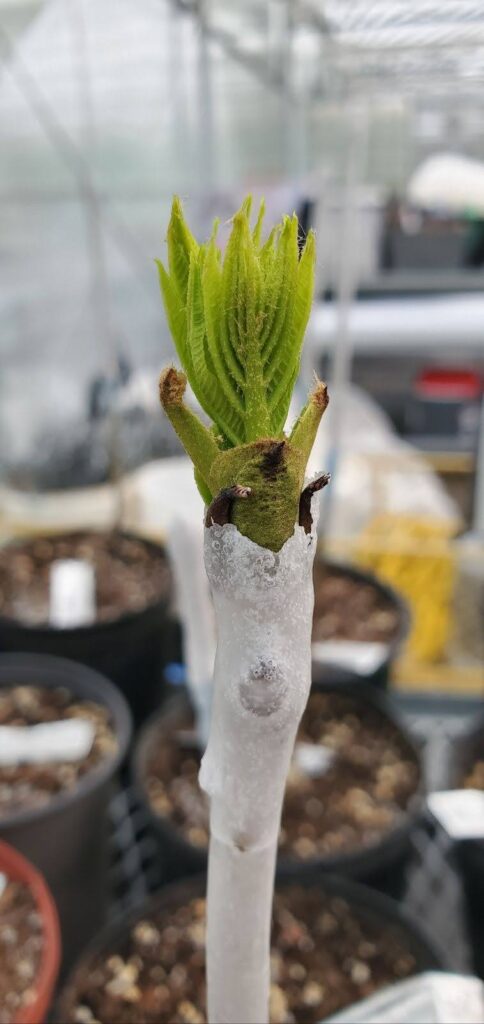
Black ash graft breaking bud in early spring, a sign of grafting success.
Why Forest Genetics Matters More Than Ever
Recovery is not only about protecting individual species occurrences. It is also about maintaining the genetic diversity necessary for populations to adapt, persist, and recover under changing environmental conditions.
This is where our work becomes increasingly important.
For decades, our organization and our extensive network of experts has supported conservation and restoration efforts across Ontario through seed conservation, gene conservation planning, climate-informed seed sourcing, ex situ conservation, and applied tree improvement and restoration programs. These activities provide the genetic foundation necessary for effective long-term forest resilience and species recovery.
As climate pressures, invasive species, habitat fragmentation, and land-use change continue to affect Ontario’s forests, conservation strategies must increasingly consider:
- genetic diversity within species;
- adaptive variation across landscapes;
- assisted migration and climate adaptation;
- conservation seed banking;
- restoration stock integrity; and
- long-term population resilience.
These are areas where the FGCA already provides leadership.
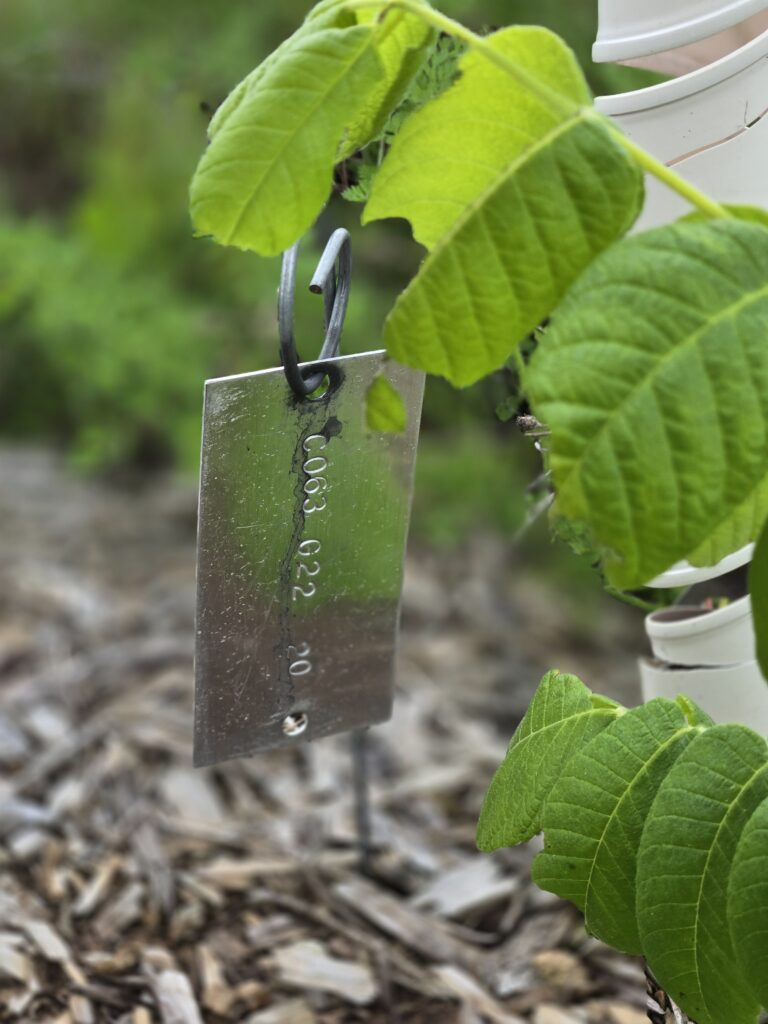
Archived pure butternut ramet representing a tree that exhibited characteristics of tolerance. Its associated tag links it to the parent tree from which it was collected, which no longer exists due to land use change.
A National Leadership Role in Recovery
Ontario’s evolving legislative framework highlights the need for strong partnerships among governments, Indigenous communities, researchers, conservation organizations, nurseries, forest managers, and restoration practitioners.
We are uniquely positioned to contribute to this work through:
- science-based conservation planning;
- seed and gene conservation expertise;
- restoration and reforestation guidance;
- collaboration with provincial and national partners;
- support for rare and at-risk tree species recovery; and
- development of climate-resilient restoration strategies.
Importantly, effective recovery requires continuity. Forest ecosystems develop over decades and centuries, not election cycles. Conservation success depends on maintaining long-term access to genetically appropriate seed, protecting adaptive diversity, and ensuring restoration efforts support resilience.
Across Ontario and Canada, there is growing recognition that successful recovery efforts must integrate genetics into conservation decision-making. Our organization continues to play a leadership role in ensuring these considerations remain central to restoration, recovery, and sustainable forest management.
Looking Forward
Ontario’s transition from the Endangered Species Act to the Species Conservation Act represents one of the most significant changes to species-at-risk policy in a generation. While the long-term implications will continue to emerge over time, one reality remains clear: recovery requires more than regulation alone.
It requires science, coordination, monitoring, restoration capacity, and long-term stewardship.
We remain committed to advancing practical, science-driven conservation solutions that support healthy, resilient forests and species recovery across Ontario and Canada — today and for future generations.
Leave a Reply
You must be logged in to post a comment.