

How Climate-Driven Spring Extremes Are Reshaping Tree Survival
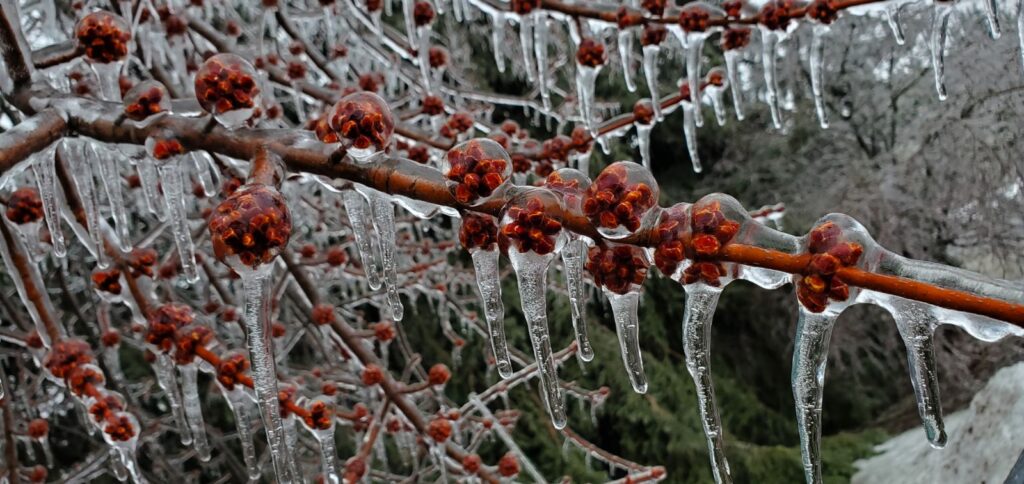
Photo credit: Briana Heuving
Spring is an exciting time with promises of renewal, longer days and anticipation for the growing season ahead. For tree species, warmer temperatures and more daylight stimulate natural processes like bud break and growth.
But with climate change we are seeing more extreme weather that can look like early spring thaws leading to premature bud break and late season frosts or ice accumulation which can damage delicate buds or developing flowers and seed.
Can tree species adapt to these changes?
Tree species have different processes that allow them to adapt (or not adapt) to changes in the environment. These processes can be combined into five broad strategies:
- Tree phenotypic plasticity (individual adaptation)
- Population phenotypic diversity (adaptation within populations)
- Genetic exchange within populations (expected to help shape overall response of a population to climate change over the longer term)
- Genetic exchange between populations (indicator of the potential for natural or artificial gene flow and population connectivity)
- Genetic exchange between species (hybridization)
Species’ ability to adapt will impact how a given tree species can persist where they currently grow. Visit the FGCA’s website to explore tree species’ vulnerability to climate change and their adaptive capacity.
This work is available thanks to the laboratory of Dr. Isabelle Aubin (Canadian Forest Service/Natural Resources Canada).
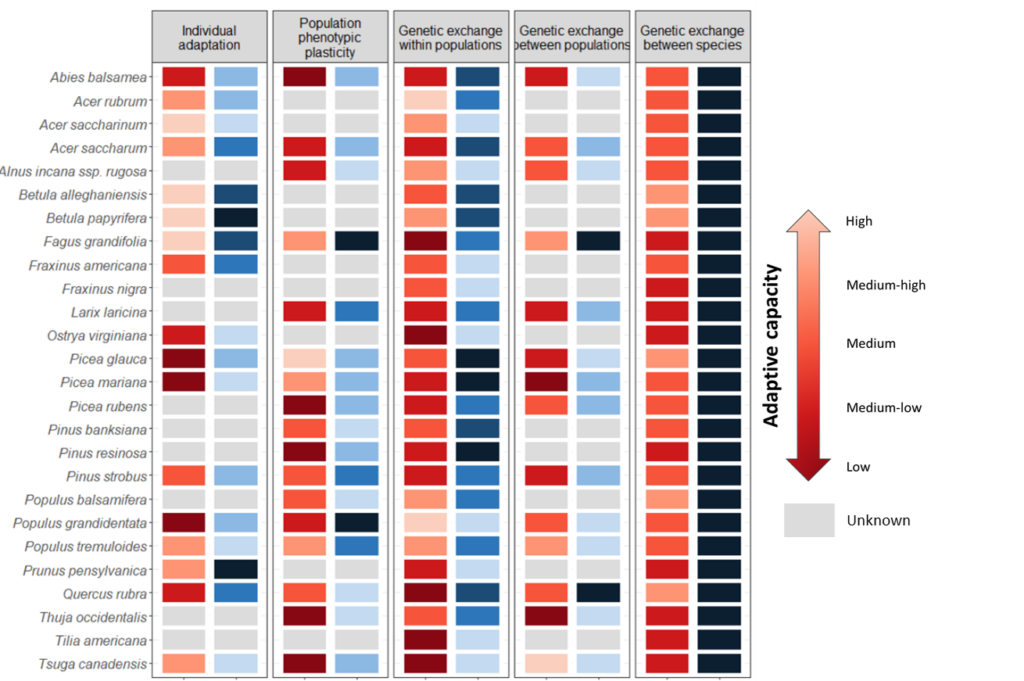
Adaptive Capacity Index: Natural Resources Canada and the Canadian Forest Service
How to use the index: For a given species, each coloured tile represents a corresponding index value (reds) and confidence value (blues). Five classes were defined of increasing adaptive capacity (from dark to light red): low, medium-low, intermediate, medium-high and high. Missing data values are classified as Data not available. Data confidence information was ranked into five confidence classes: low, medium-low, intermediate, medium-high, high. Missing data values are attributed Data not available.
Leave a Reply
You must be logged in to post a comment.